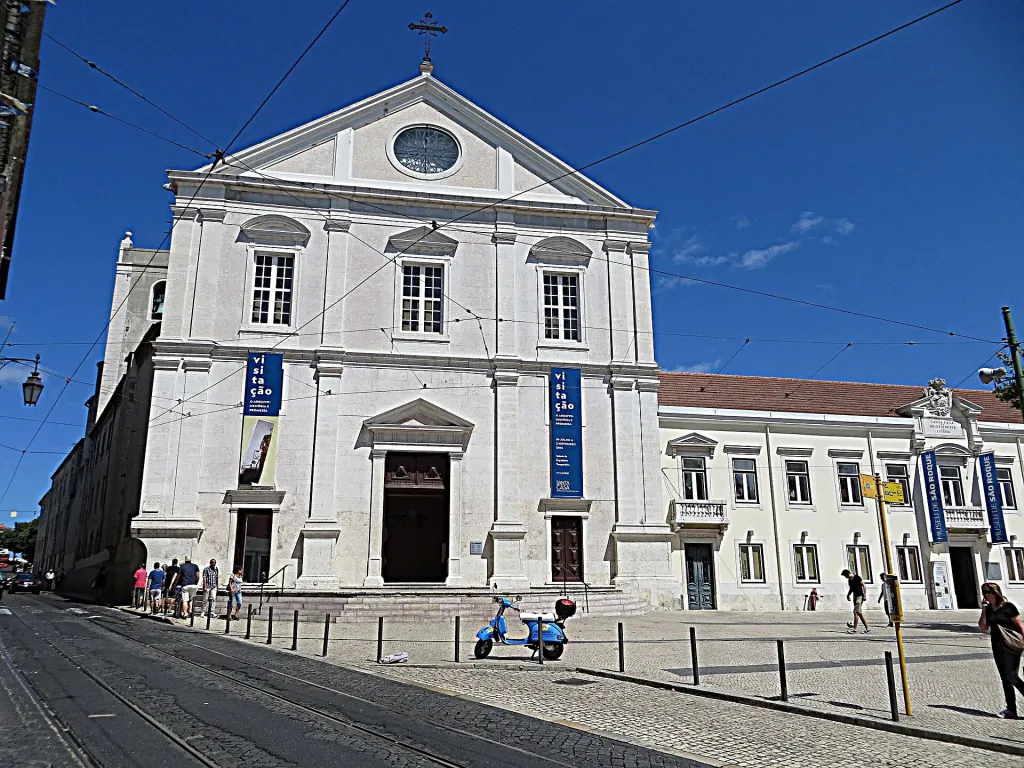
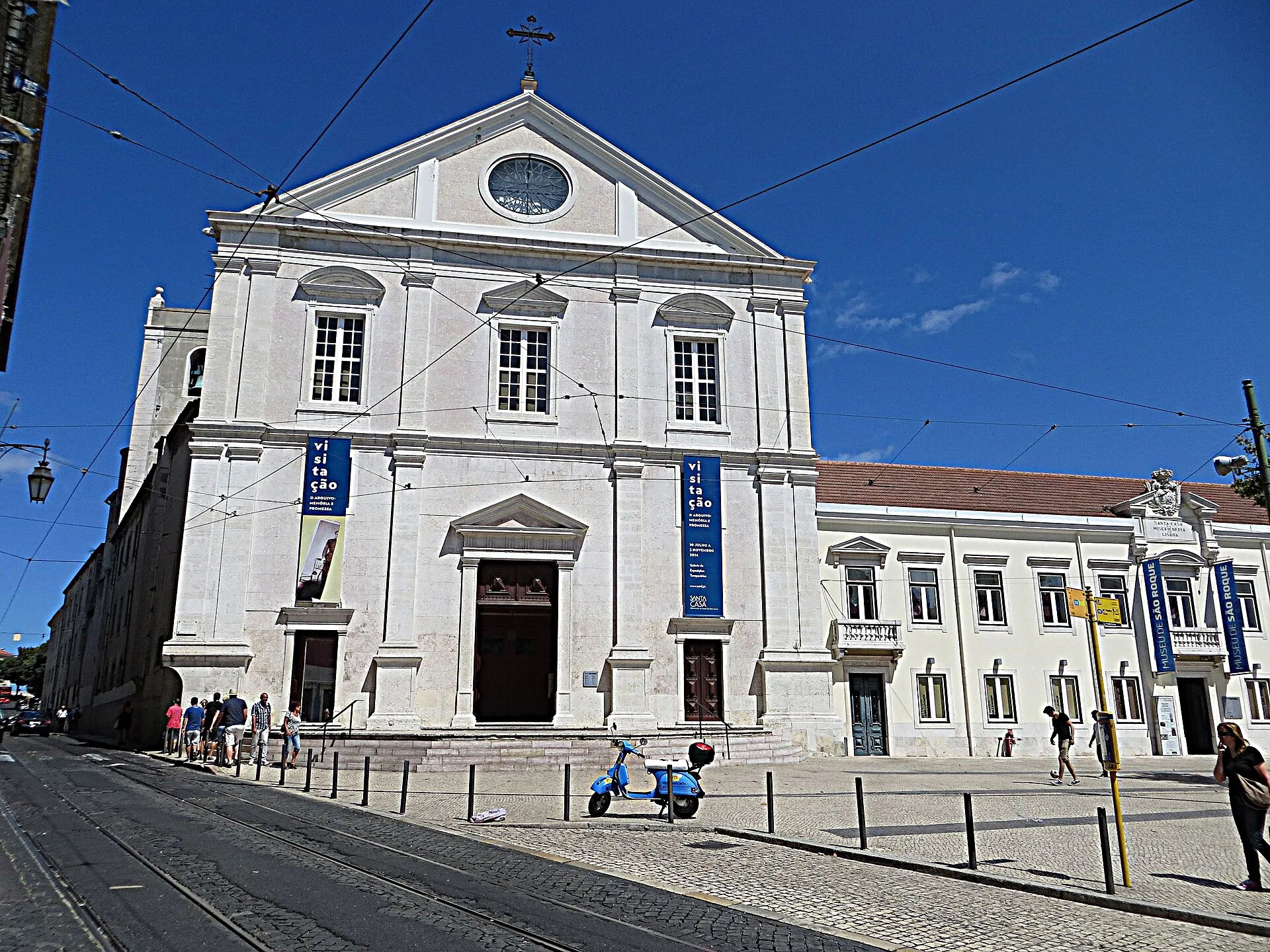
The Igreja de São Roque was one of the few buildings in Lisbon to survive the earthquake relatively unscathed. When built in the 16th century it was the first Jesuit church designed in the “auditorium-church” style specifically for preaching. It contains a number of chapels, most in the Baroque style of the early 17th century. The most notable chapel is the 18th-century Chapel of St. John the Baptist (Capela de São João Baptista), a project by Nicola Salvi and Luigi Vanvitelli constructed in Rome of many precious stones and disassembled, shipped, and reconstructed in São Roque; at the time it was reportedly the most expensive chapel in Europe.
In 1505 Lisbon was being ravaged by the plague, which had arrived by ship from Italy. The king and the court were even forced to flee Lisbon for a while. The site of São Roque, outside the city walls (now an area known as the Bairro Alto), became a cemetery for plague victims. At the same time the King of Portugal, Manuel I (reigned 1495–1521), sent to Venice for a relic of St. Roch, the patron saint of plague victims, whose body had been translated to that city in 1485. The relic was sent by the Venetian government, and it was carried in procession up the hill to the plague cemetery.
The inhabitants of Lisbon then decided to erect a shrine on the site to house the relic; the shrine was begun on 24 March 1506 and dedicated on 25 February 1515. This early shrine was oriented from west to east, in the medieval tradition. A “Plague Courtyard” for the burial of plague victims adjoined the shrine and was formally dedicated on 24 May 1527 by Bishop Ambrósio. At about the same time a Brotherhood (or confraternity) of St. Roch was established to oversee and take care of the shrine. Made up of people from all classes, the Brotherhood still exists today, and maintains the Chapel of St. Roch in the present church.